i wonder who  

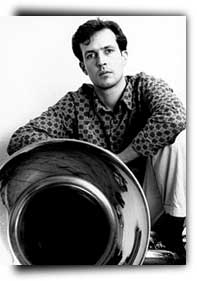
Tuba, Percussion, Composition


Born in 1966 in Freiburg, Carl Ludwig Hübsch began basic training in music at the age of five. He played clarinet in the local traditional band and at the same time started to play drums in Punk and Rockbands. Around 83 he exchanged the clarinet for a tuba. Lessons with W.Erhart from the local orchestra followed. He experimented with all kinds of music including an incredibly bad dance music trio and a New Orleans Sextet.
The discovery of Jazz and Improvisation led to studies in Improvisation with M.A.Fataah. Hübsch received certification at the Pedagogic College in Freiburg in singing, theory, drums and electronic music. Since 1990 Carl Ludwig Hübsch has lived in Cologne where he finally awarded a livelong stipendium from himself. Actually he studies composition as a guest at the university of Cologne.

C.L.Hübsch works as a musician and composer lending his talents to ensembles and orchestras. He is well known for his unique solo concerts. He concentrates on Improvised Music and Composition. He also leads workshops for tuba and improvisation.

Since 89 he performed with such renowned musicians as Thomasz Stanko, Matthias Schubert, Ernst Reijseger and Frank Gratkowski. Concerts with the Arthur Blythe Quartett in 92, participation in the Humanoise Congress Wiesbaden in 94 and tours with Hannes Zerbe/Willem Breuker Blech Band and the October Orchestra 94 in Amsterdam featuring the ICP Ensemble and guests have secured him a reputation as a well-rounded musician. Tours with Lester Bowie`s Brass Fantasy followed in 95 and 96. Concerts with planetBlow in India and studies with Ramamani from the Carnataka College of Percussion took place in 1997. The recording of the Solo CD and the concert with the Matthias Schubert Sextet at the JazzFest Berlin were other 97 highlights. In January/February 2000 Hübsch played and traveled in Namibia, Africa.

Since end of 98 Hübsch has his own trio which features Matthias Schubert on tenorsaxophone and Wolter Wierbos (Amsterdam) on trombone. A SWR recording took place in 10/99. Carl Ludwig Hübsch has collected experience with theatremusic in many productions, including the improvised theatrical concert 'Blauzone', directed by Beat Fäh and played by members of the band PostNoBills. The Premiere was in March 1997 in Zurich at the BlickfelderFestival. In fall 99 C.L.Hübsch played in the chamberopera 'Idyllen' for two basses, stringquartet and tuba written by Thomas Beimel.

Some Recordings:
Vertrauensbildende Massnahmen: B-tales (MIC 8852-2)
Lines in Space: Spacelab (RISK944101)
Planet Blow: Alien Lunatic (JHM 71)
PostNoBills: defense d`afficher (AMF 1044)
Hübsch: Der erste Bericht, Tubasolo (IOR CD 77035-2)
Planet Blow: Chill (JHM 87)
Zoepf/Theurer/Hübsch: Konferenz der Köche (HF 6)


Some projects:
Hübschs Logrunning Development Of The Universe (Schubert, Wierbos, Hübsch)
Huebsch/Kimmig/Le Quan Trio
Huebsch/Kimmig Duo
Planet Blow (Hanschel, Hübsch, Schipper),
Ramesh Shothams Madras Special
Vertrauensbildende Massnahmen (Bell, Hubweber, Hübsch),
Toiteens lil rosies (Buhrs, de Joon, Klare, Hübsch)
Theurer, Zoepf, Hübsch
Schlotte, Hübsch und Heinrich
European Tuba Quartett (Moschner, Fishkind, Wauschke, Hübsch)
Bull's Eye Ensemble,
Blauzone,
soloconcerts.

solo concerts:
"My current solo concerts focus on music as a structure in time. All focus is on the genesis of the moment. While emphasis and plot are fragmented and given the freedom of a new point of departure, utmost care is given to awareness of musical flow and continuity of the play.
Through the use of avant-garde and self-invented performance techniques, the tuba acquires completely new characteristics as a brass instrument. An innovative array of unexpected sounds is heard, the instrument is seen from a fresh perspective, and the audience is confronted with a novel way of perceiving time."

Liner Notes for "Der erste Bericht":
"Tuba Space Travel "
"Narratio prima" is the title Nicolaus Copernicus chose for his first book, published in 1540: a "first report" ("erster Bericht") about an
iconoclastic reinterpretation of cosmic order, replacing the traditional geocentric concept with the revolutionary model of a heliocentric universe.
Why should a tuba player name his first solo record after Copernicus? And why should he select the titles of his improvisations according to the
cosmic objects listed in the star catalogues compiled by the French astronomers Charles Messier ("M1", "M2" etc.) or Nicolas Louis de Lacaille?
"I know virtually nothing about astronomy", Carl Ludwig Hübsch claims (a statement which is more a reflection of his innate modesty than a true
representation of the facts), and his music is certainly not "cosmic music" in the obvious way such references to astronomy may imply. Neither do his pieces attempt to mirror cosmic proportions, nor are they based on the visual structures of star charts (like John Cage's orchestra piece "Atlas Eclipticalis" or his "Etudes Australes" for piano). Hübsch's titling procedure could thus seem to be no more than just another elegant way of circumnavigation the dilemma many contemporary improvisers face when forced to name their spontaneous creations. But there is more to it than that. For the Cologne-based musician the history of astronomy is a model for the eternal human quest for structure and meaning within a chaotic universe, a striving for clarity and content which also permeates the activity of musical improvisation. Astronomers do not observe "reality", but interpret unknown worlds according to manmade models and principles. In fact, the astronomer, peering into space, is bound to discover his own mirror image, or, as Hübsch puts it: the object of observation is invariably the observer himself. And the same certainly applies to man's attempts to find order in the cosmos of sound. Improvisers and listeners are intent on finding "objective" structures, but, in fact, they discover themselves. Making music and listening to music are nothing but lifelong processes of selfdiscovery and soul-searching. And so Carl Ludwig Hübsch's orbit through the infinite cosmos of tuba-modulated sounds reflects his own story as a composer and improvisor, his own sonic worldview. Knowing that Hübsch, apart from his training as a brass player, also studied percussion and singing, it may not come as a surprise that this virtuoso tuba player should explore the percussive and vocal extensions of brass technique in depth. In "Ross 780", Hübsch not only gradually transforms the tuba into a complete drum kit, but also manages somehow to add a melodic line on top. And "M5" is nothing less than a complete polyrhythmic drum choir - plus vocals. Other pieces investigate the eerie soundworld of a reed-blown tuba ("M3") or the multiple possibilities of extended multiphonic techniques (e.g. "Lacaille 8760", "Wolf 424"), and "M6" transcends the traditional physical limits of wind instrument phrasing, utilizing eivculat breathing to build continuous, richly modulated multiphonic layers. Following Hübsch's journey through tuba space, one comprehends that the tuba is far a filter and modulator for the entire panorama of human vocal expression, But "Der erste Bericht" is not just a survey of tuba territory. Even if some of Hübsch's sonic miniatures are virtuoso showcases, one should not overlook another, no less impressive aspect of Hübsch's playing: his ability to built coherent structures and explore subtle nuances within a strictly confined sonic area, abstaining from the spectacular effects of "extended techniques" e.g. in the pianissimo world of "Prokyon" or the motivic cell proliferations of Goombridge 34". In other words: Carl Ludwig Hübsch is not only a first-rate tuba player, but also world-class musician - as can be witnessed on this CD, or in Hübsch's playing in his own ensembles ("PostNoBills", "Planet Blow", "Massnahmen", among others) and his various sideman activities with the likes of Lester Bowie, Henry Threadgill, Thomasz Stanko and the ICP ensemble. "Der erste Bericht": Welcome to tuba space, and welcome to the sound of music.
Peter Niklas Wilson

Hübsch-Schubert-Wierbos
Hübsch`s Longrunning Development of the Universe
Upon completion of his solo CD Carl Ludwig Hübsch turned his talents to ensemble work. His preference for wind instruments and lower frequencies has led to the formation of a high-calibre constellation: Matthias Schubert on tenorsaxophon and Wolter Wierbos, trombone, are participating in this challenging project. Wellknown as improvisers and instrumentalists they contribute a unique awareness of new concepts. All compositions are written especially for this trio making use of the characteristic play style of each musicians. New Music and Modern Jazz influences pervade the program which combines the forces of restructured improvisation and composed elements.
> Matthias Schubert (Gunter Hampel Duo, Albert Mangelsdorf Quintett, Klaus König Orchestra, Marty Cook Band, M.Schubert Quartett/Sextett, Schubert/Gratkowski Duo etc.) tenorsaxophone
> Wolter Wierbos (ICP Ensemble, Gerry Hemingway Quintet, Podium Trio (van Kemenade/Kuiper), Maarten Altena Ensemble, Curtis Clark Sextet, Albrecht Maurer Quartett, Available Jelly etc.) trombone
> Carl Ludwig Hübsch (Planet Blow, Post No Bills, Lester Bowie`s Brass Fantasy, Arthur Blythe, Schubert Sextett, European Tuba Quartett, Buck Hübsch Mahall, Vertrauensbildende Massnahmen etc.) tuba

Hübsch - Kimmig - Le Quan Ninh
tuba, violine, percussion
Three independent musical energys encounter in di- and trialogues. Out of their own languages and sounds they develop a music which is created in the moment of playing. Consonances, tensions, unexpected turns, silence and open sounds connect in a musical sensation that can not be repeated. Every concert is unique and with every note they play the musicians and their audience step into the unknown.
Le Quan Ninh, Carl Ludwig Hübsch and Harald Kimmig are wellknown players in Improvised Music. They worked together with Peter Kowald, Cecil Taylor, Steve Lacy, Lester Bowie and many other renowned musicians. Each musician has developed his own sound which is documented on several CDs and radio recordings.

Carl Ludwig Hübsch
European Tuba Quartet
Post No Bills
Plattformkonzerte pictures 1
Plattformkonzerte pictures 2


mailto: carl.ludwig.huebsch@nurnichtnur

   
    Available at NURNICHTNUR:
  "" "" 'james choice orchestra - live at musik triennale köln' - CD 2008
  "" "" 'run-run' - DVD 2007
  "" "" 'Primordial Soup' - CD 2007
  "" "" 'James Choice Orchestra - Live at Moers' - CD 2006
  "" "" 'Longrun Development of the Universe 2 - is this our music?' - CD 2005
  'The F-Orkestra - Compositions' - CD 2005
  'Post No Bills - Musik für Kammerensemble' - CD 2004
  'European Tuba Quartet - Echo-Nomia 4.4' - CD 2003
  'Improvisors' - CD 2003
  '119 Arten zu beginnen' - CD 2002
  "" "" 'Longrun Development of the Universe' - CD 2001
  'Kaffee & Kuchen' - CD 2001
  'Konferenz der Köche' - CD 1999
  'Tuba - Der erste Bericht' - CD 1997
  back

